
Why I created Kindred Grove
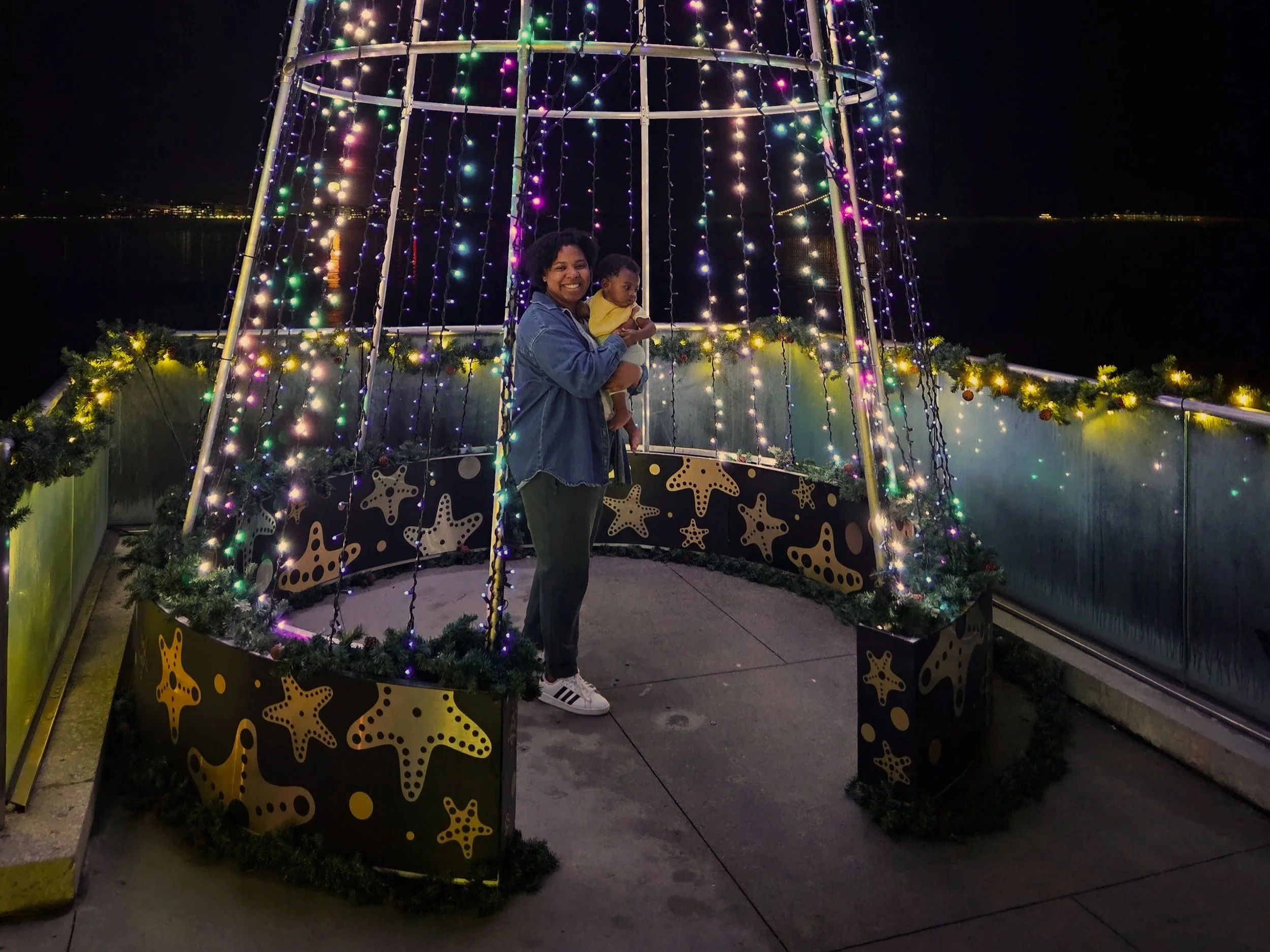
Me and my little one celebrating the holidays with their first trip to the Aquarium
I felt so alone throughout my journey to parenthood.
I listened religiously to podcasts like The Queer Family Podcast with Jaimie Kelton, hoping to hear stories like mine. It didn't take long to realize that having children as queer person can be incredibly expensive, and the representation of Black, queer birthing people was almost nonexistent. The closest resource I found was Fertile, a program by Jose Rodriguez-Bouchier of Intersectional Fertility for queer folks with wombs. While the space was BIPOC, I longed for more specific representation as a Black, queer mama.
All in all, I was navigating my fertility and pregnancy largely on my own.
I found solace in the Mocha SMCs podcast, but when I tried to join their community, I was rejected. Apparently, being nonbinary automatically categorized me as a man. Moments like that made my identity feel imaginary.
On top of that, I didn't know what a "good parent" was. I knew exactly what I didn't want to be. I knew what cycles I refused to continue. But without a model of the family I wanted to create, I had no blueprint for the kind of parent I wanted to be.
The Illusion of Support
My path to parenthood changed suddenly.
I had planned to co-parent with an ex-partner. After our separation, I had to grieve that dream while simultaneously figuring out how to build a family solo.
When I reached out to the same fertility center I'd been using, I hit a bureaucratic wall. My provider said I needed my partner's permission to use a sperm donor even though we were separated. I had to find a way to build a family where I could be in charge of my own body.
I eventually had the birth I wanted: a peaceful waterbirth at home with a Black midwifery team.
Afterwards, I felt unexpectedly empty.
There were people in the room, but no one was truly with me. My midwives assumed that because I'd taken a childbirth class as they'd recommended months earlier, I should already know everything. When I voiced concerns, they were downplayed. My doula replaced herself last minute with someone with no home birth experience without an introduction or proper handover.
Everyone fulfilled their role, but I wanted something more intimate. I wanted care that felt connected.
That experience taught me a hard lesson: having people present is not the same as having a village.
After my child was born, I faced another battle. I navigated a legal system that required me to prove I was the sole fit parent for my child. In a state without protective laws, I had to beg for recognition of the role I had held since my child's birth.
The Reality of Survival
The challenges continued after my child was deemed healthy, the final postpartum check-ups were complete, and the meal train ended. When it was just my baby and me, I was a full-time caregiver without much time to care for myself.
Self-care looked less like spa days and shopping sprees and more like carefully constructed survival. I built strict routines to have time to occasionally shower and brush my teeth.
My only break came during naps.
I tiptoed around the house to grab a snack from the fridge. I collapsed into a chair to watch a TV show in the farthest corner on the lowest, audible volume.
The older my child got, the shorter the nap. For a while I had no break at all.
I always dreamed of a gentle homeschooling rhythm with occasional drop-ins at a Montessori-based daycare. But the reality looked very different. I lost a job that allowed me to bring my child to work, and had to move to an area where the childcare options were few and poor quality.
Traditional work meant masking all day, coming home exhausted, and barely connecting with my child before bedtime. I had already experienced the early years that way. I wanted to be a more present parent, to know my child and build a strong relationship with them. Both paths promised hardship without a support network.
So, I chose my hard and stayed home.
Some days are purely about getting through. I try to show myself the same compassion I offer my child, reminding myself that wanting a break is normal, even necessary.
Parenting is hard work.
Parenting without a safety net is even harder.
Why Kindred Grove?
Kindred Grove was born from the realization that I couldn't keep fighting these battles alone, and no one else should have to either.
Kindred Grove is a place for parents, caregivers, and villagers to learn to live in right relationship with children, each other, and the living world. We center Black, queer, and disabled parents who have been told they are too much, too different, or simply invisible.
In the Grove, I want people to feel welcome exactly as they are. I want us to trust our intuition alongside trusted knowledge rather than surrendering it to dismissive systems. I want us to find connection that honors our capacity and lived experiences.
I started this space because I learned that surviving parenthood alone is possible, but thriving requires community.
We need more than parenting how-tos. We need places where our stories are reflected, and where geography, schedules, or accessibility don't limit community.
Kindred Grove offers asynchronous reading circles, self-paced classes, and a growing library of resources to help parents build the support, knowledge, and confidence they need to parent intentionally.
I invite you to join me in building the village we all need and deserve.