
Accepting Where I’m Meant To Be
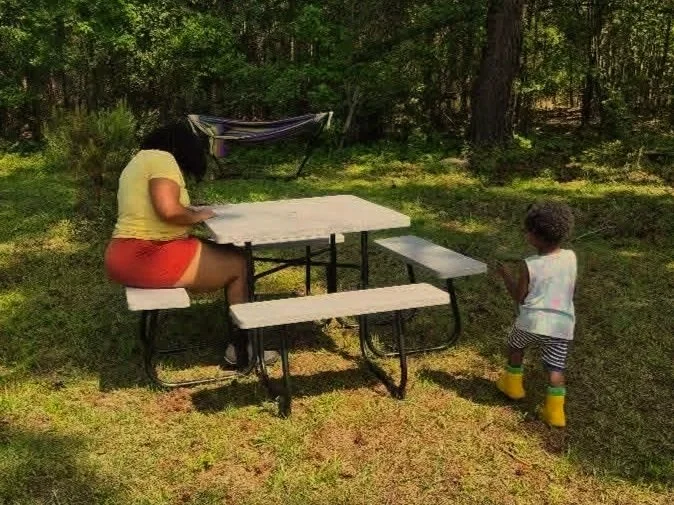
Me and my little one enjoying a perfectly sunny day in the yard. I’m sitting at a plastic picnic table, wearing a yellow t-shirt, red orange skort, and garden boots. My child wanders close by with a floral tank top, striped shorts, and yellow rubber boots.
I co-purchased land in 2019, but have only recently made it my home. Back then, I lived with my ex, who was stationed near DC. Both of our families lived in the Southeast, so this home was meant to be a gathering place for all of us. Bonus: there was enough room for an intentional community. Originally, we commuted six hours back and forth on holidays and breaks. While my partner was deployed, I moved into a 20-ft RV there to be on the land but have distance from my in-laws, who occupied the house. I barely made it through the first winter because of the constant need for propane refills. In spring, my dog brought in a family of fleas that quickly turned into an infestation. It only took six months to realize that I couldn't live like that anymore. I moved to a nearby city where my partner and I purchased a separate house for me to live in, while the land remained a joint asset. In the urban home, the backyard flooded even though it wasn't in a flood zone. I lost everything I planted there. In the front yard, a sinkhole developed next to the light pole. So it goes without saying that I did not fight for that house in the divorce. I managed to hang on to the rural property by selling the structure on it and keeping the land.
Despite being pulled away multiple times, I kept running back to this land every chance I could, trying to make it into my vision of an intentional community and food forest. I hosted a land stewardship training there, listening to other stewards share their visions for their own spaces as we toured the property. I even went through the complicated process of subdividing the land (which meant convincing my ex to sign it over their official rights) to gift to friends. Just as the paperwork was finalizing, their true character was revealed. I learned that they weren't even my friends, and definitely wouldn't make good neighbors after all.
I was originally writing this to say that you don't need access to land to have a connection to nature. My therapist suggested I move because I'm having a hard time navigating isolation. But as I was researching other places, I couldn't wrap my head around losing access to this land. Staying here allows me to keep my farm dream alive: a business model that aligns with my energy fluctuations and lets me care for my child. Plus, as an autistic person, long drives or heavy traffic stress me out, so being able to limit my driving here is a huge relief. I wouldn’t trade my isolation, spiritual connection, and access to land for creature comforts, better job markets, or the psychological stress of city life. While those perks sound appealing to some, given how my brain and body are wired, what this land offers is non-negotiable.
This land holds me when I'm going through it. It comforts my child when they are fussy or bored. I feel my ancestors here, though I'm not aware of any ancestral ties. Of course, I acknowledge the great privilege it is to have unlimited access to open space, a piece of peace, while I complain about how hard it's been to keep it.
The hard part, though, has been not prioritizing my calling to this place. Or thinking that it was hard because I wasn't meant to be here. I believe that it was hard because so much of my life was out of alignment with where I wanted to be. I was dreaming about being on the land when I was away, trying to bring pieces of it wherever I went. This space has been nothing but good to me. Since I've been back, I find myself in Zoom calls distracted by a red cardinal dancing across the yard, or rabbits hopping to see what's uncovered in the garden. Crickets, frogs, and ladybugs greet me day and night. I've never felt so connected to the world around me, and I know that I would feel differently if I lived somewhere else.